
Lights, Camera, Action!
The suggested measurements listed below refer to the string height at the 1st fret and also at a higher fret. Measured for the outermost bass and treble strings. These are ‘baseline’ heights you should aim for however they can be tweaked depending on whether you prefer a lower or higher action.
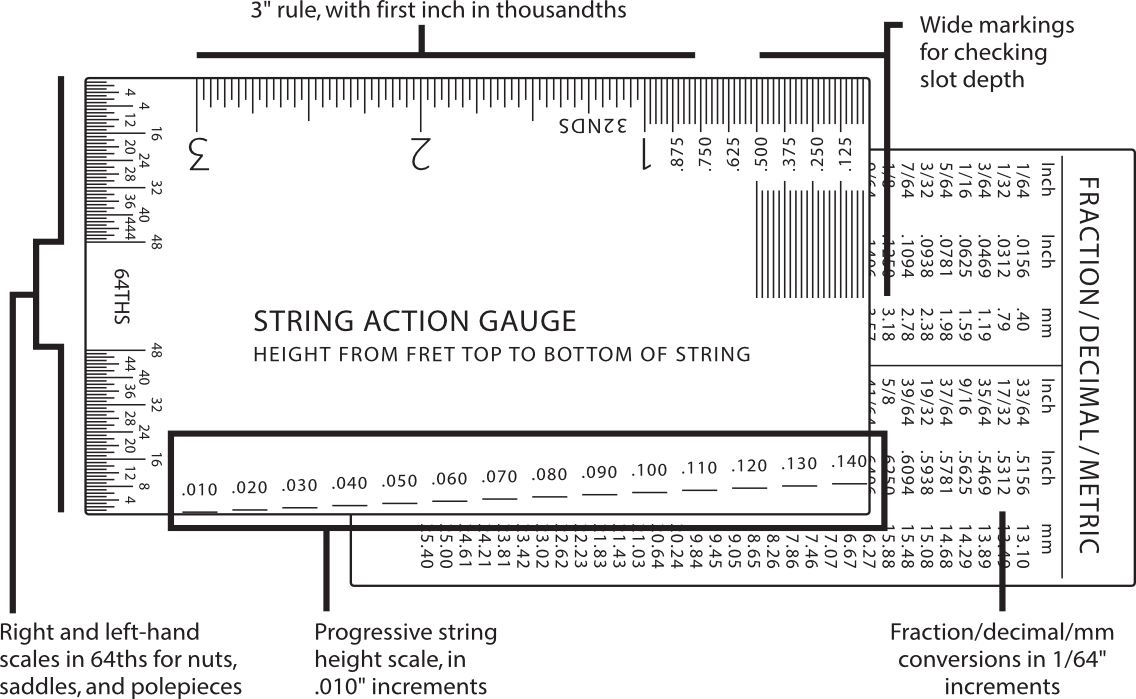
You should measure string action (the height of the string above the fret) at any point by placing the gauge behind the string. The string height markings (on the image above, and pretty much any string action gauge available) are at increments of .010″ (ten thousandths of an inch). When the bottom of a mark aligns with the bottom of the string, that measurement is the string height at that point.
The markings themselves are .005″ thick, so referring to the top of a mark instead of the bottom adds .005″ to the measurement. In this way the progressive string height scale measures in .005″ increments.
I have seen it mentioned around the interwebs that you should check the action with the guitar in the playing position, I’ve never really noticed a difference myself.
Recommended String Action Heights
Steel string acoustic guitar
Relief: .002″ at the 8th fret
Action at the 1st fret
Bass E
0.023″
0.58mm
Treble E
0.013″
0.33mm
Action at the 12th fret
Bass E
0.090″
2.29mm
Treble E
0.070″
1.78mm
Nylon string acoustic guitar
Relief: .002″ at the 8th fret
Action at the 1st fret
Bass E
0.030″
0.76mm
Treble E
0.024″
0.61mm
Action at the 12th fret
Bass E
0.156″
3.96mm
Treble E
0.125″
3.2mm
Electric guitar
Relief: .001″ at the 8th fret
Action at the 1st fret
Bass E
0.024″
0.61mm
Treble E
0.010″
0.25mm
Action at the 12th fret
Bass E
0.078″
1.98mm
Treble E
0.063″
1.6mm
Bass guitar
Relief: .014″ at the 7th fret
Action at the 1st fret
Bass E
0.022″
0.56mm
Treble E
0.020″
0.51mm
Action at the 17th fret
Bass E
0.105″
2.39mm
Treble E
0.063″
1.6mm